Pronouns are words that are used to replace nouns in a sentence. They help in avoiding repetition and make the sentences more concise. Pronouns can refer to people, places, things, or ideas. They play a crucial role in making the language more fluid and natural. Here are some examples of pronouns:
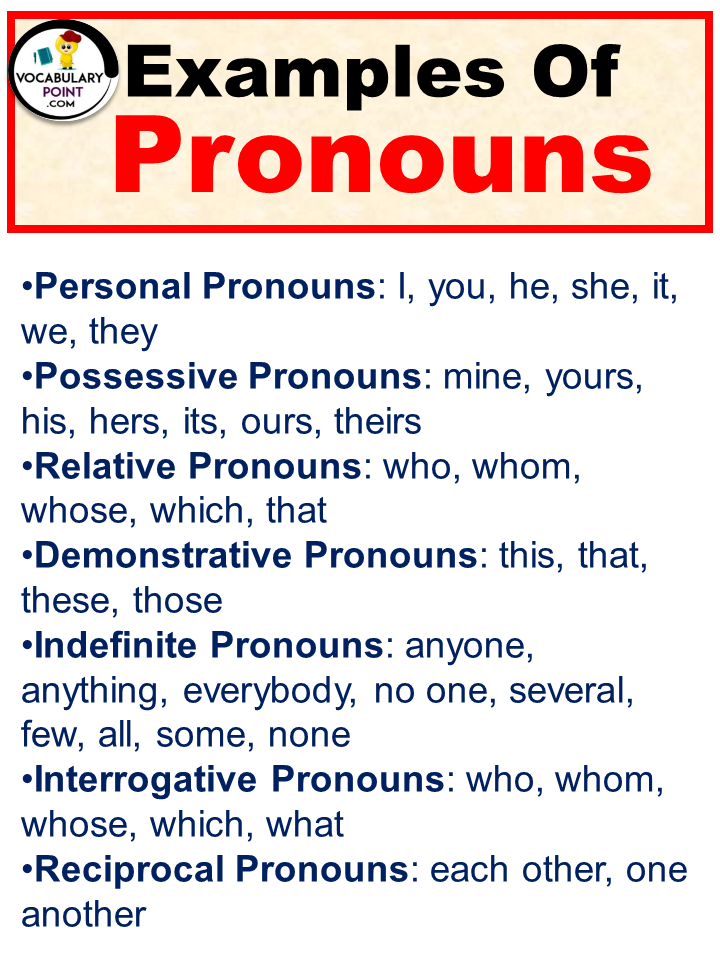
Personal pronouns are used to refer to specific people or things. They can be divided into three categories: subjective pronouns, objective pronouns, and possessive pronouns. Subjective pronouns are used as the subject of a sentence, while objective pronouns are used as the object of a verb or preposition. Possessive pronouns show ownership or possession. For example, “He went to the store” (he is a subjective pronoun), “I gave her the book” (her is an objective pronoun), “That is their car” (their is a possessive pronoun).
Demonstrative Pronouns
Demonstrative pronouns are used to point out specific people or things. They indicate whether the noun is near or far from the speaker. Examples of demonstrative pronouns include “this,” “that,” “these,” and “those.” For instance, “This is my house” (this refers to something close to the speaker), “I want that book” (that refers to something far from the speaker).
Relative Pronouns
Relative pronouns are used to introduce a dependent clause and connect it to an independent clause. They refer back to a noun mentioned earlier in the sentence. Some common relative pronouns include “who,” “whom,” “whose,” “which,” and “that.” For example, “The man who was sitting next to me is my brother” (who refers to the man), “The book which I bought yesterday is interesting” (which refers to the book).
Indefinite Pronouns
Indefinite pronouns do not refer to any specific person or thing. They are used when the noun being referred to is unknown or not specified. Examples of indefinite pronouns include “everyone,” “something,” “anyone,” and “nothing.” For instance, “Everyone is invited to the party” (everyone is an indefinite pronoun).
In conclusion, pronouns play a vital role in the English language by replacing nouns and making sentences more concise. They help in maintaining the flow of the language and avoiding repetition. By understanding the different types of pronouns and their examples, you can improve your writing and communication skills.