Grammar can be a tricky subject, especially when it comes to understanding the proper use of gerunds and infinitives. These two forms of verbs can often be confusing for English learners, but with a little practice and knowledge, you can master their usage.
Gerunds and infinitives are both verb forms that can function as nouns in a sentence. They have different uses and can be used in various ways depending on the context. Let’s explore the differences between gerunds and infinitives and how to use them correctly.
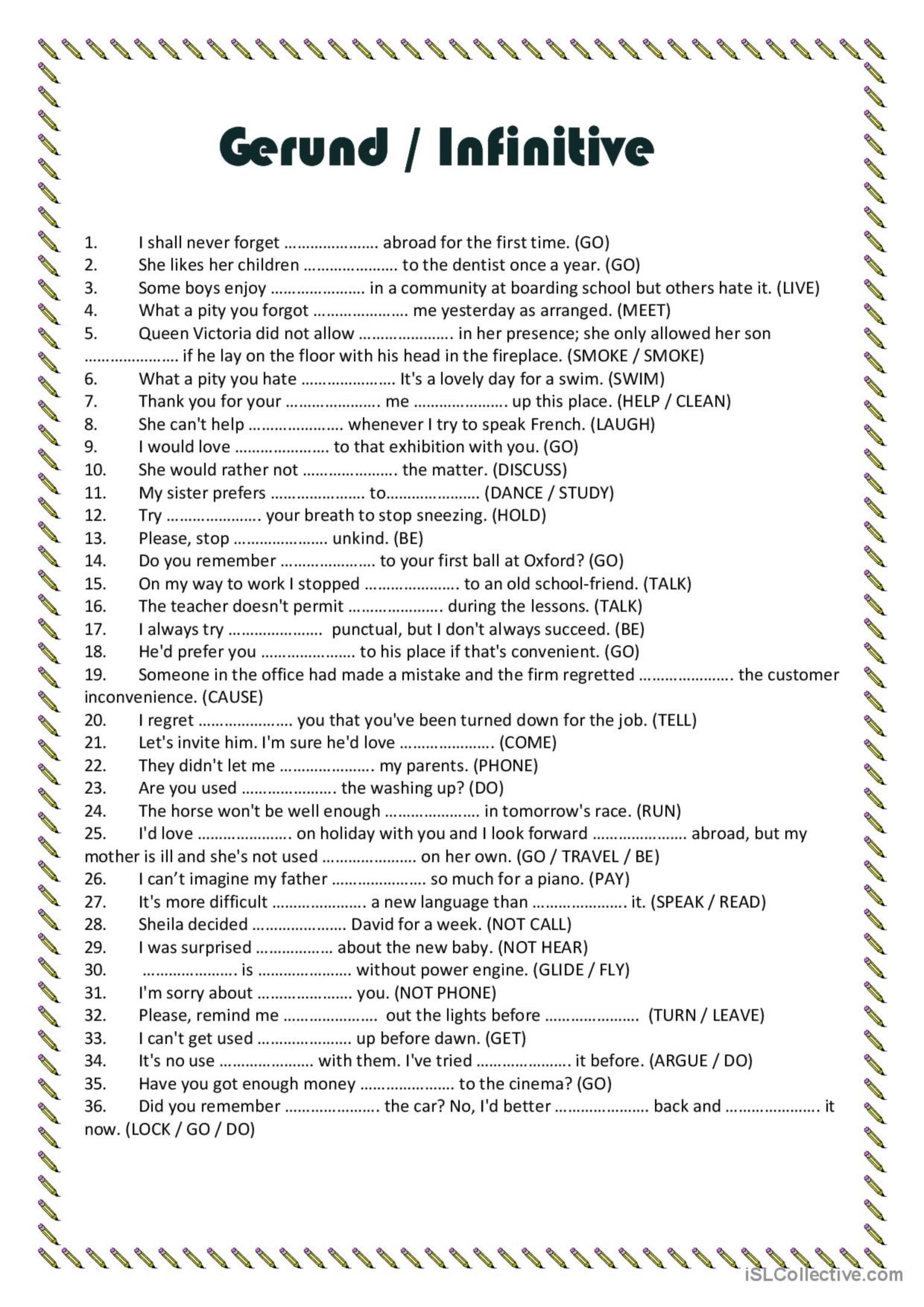
Gerund and Infinitive Grammar
A gerund is a verb form that ends in -ing and functions as a noun in a sentence. Gerunds are used to talk about actions or activities. For example, “Swimming is my favorite hobby.” In this sentence, “swimming” is a gerund that acts as the subject of the sentence.
On the other hand, an infinitive is the base form of a verb with the word “to” in front of it (e.g., to swim, to eat). Infinitives can also function as nouns, but they are often used to express purpose or intention. For example, “I want to learn how to play the guitar.” In this sentence, “to play” is an infinitive that expresses the purpose of the action.
It’s important to know when to use gerunds and infinitives in a sentence. Gerunds are commonly used after certain verbs such as enjoy, dislike, and avoid. For example, “I enjoy swimming in the ocean.” Infinitives, on the other hand, are often used after certain verbs like want, need, and plan. For example, “I need to buy some groceries.”
Both gerunds and infinitives can also be used after prepositions, but the choice between them can change the meaning of the sentence. For example, “I look forward to meeting you” (infinitive) means anticipating an event in the future, while “I am interested in learning Spanish” (gerund) means having an interest in the action itself.
By understanding the differences between gerunds and infinitives and practicing their usage, you can improve your English grammar skills and communicate more effectively. Remember to pay attention to the context and the verb that precedes the gerund or infinitive to choose the correct form.
With practice and patience, you can become more confident in using gerunds and infinitives in your writing and speaking. Keep practicing and exploring different examples to become more familiar with their usage. Happy learning!