When learning English, one common struggle that students often face is understanding when to use a gerund or a “to” infinitive. Both forms have their own rules and can be used in various contexts, making it important to practice and understand the differences between them.
Gerunds are formed by adding “-ing” to the base form of a verb, while infinitives are formed by using the word “to” followed by the base form of the verb. Knowing when to use each form can greatly improve your English writing and speaking skills.
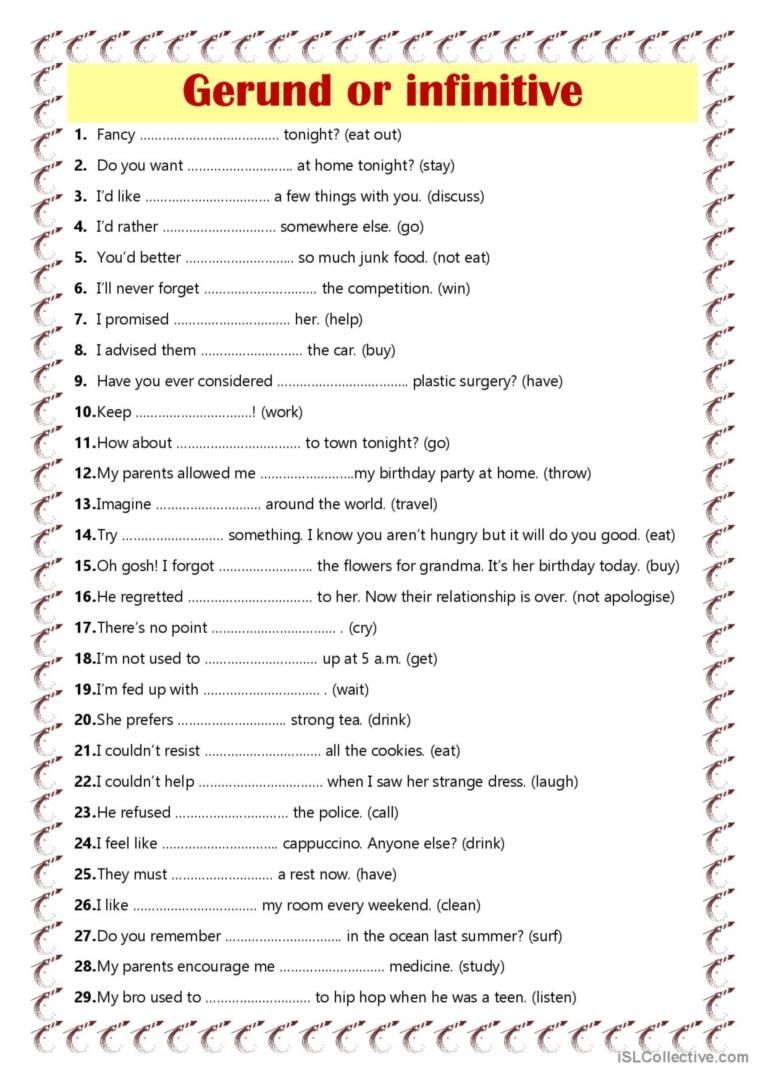
Exercise:
1. She enjoys (read) _________ novels in her free time.
2. I need (buy) _________ some groceries at the store.
3. They are considering (take) _________ a trip to Europe next summer.
4. He suggested (watch) _________ a movie after dinner.
5. We plan (visit) _________ the museum this weekend.
When deciding whether to use a gerund or infinitive, it is helpful to remember that gerunds are often used as the subject or object of a sentence, while infinitives are used after certain verbs such as “want,” “need,” “plan,” and “suggest.” Practice with exercises like the ones above can help reinforce these rules and improve your understanding of when to use each form.
By consistently practicing exercises like these, you can build your confidence in using gerunds and infinitives correctly in English. Remember to pay attention to the context of the sentence and the verb that precedes the gerund or infinitive to ensure that you are using the correct form.
Overall, mastering the use of gerunds and infinitives is an important step in becoming fluent in English. With practice and dedication, you can improve your skills and communicate more effectively in both written and spoken English.