Gerunds and infinitives are two types of verb forms that can be used in sentences to convey different meanings. Understanding how to use gerunds and infinitives correctly can help improve your English language skills.
Gerunds are verb forms that end in -ing and function as nouns in a sentence. They can be used as subjects, objects, or complements. Infinitives, on the other hand, are the base form of a verb with the word “to” in front of it. They can also function as nouns, but they can also act as adjectives or adverbs.
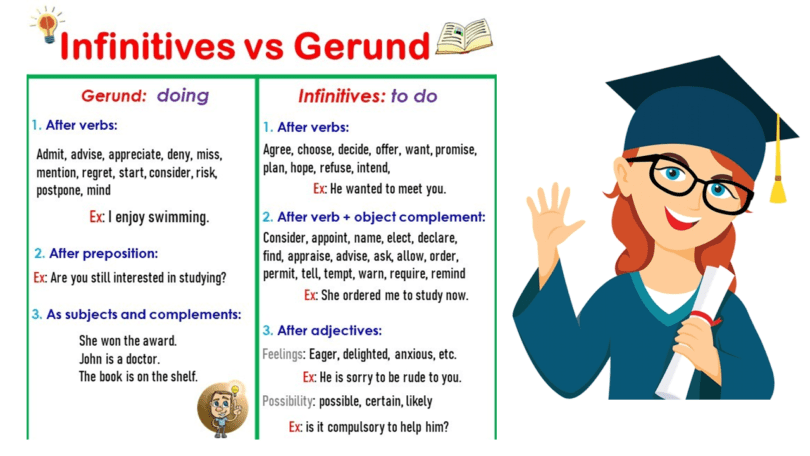
Examples of Gerunds and Infinitives
1. Gerunds as subjects:
– Swimming is my favorite hobby.
– Running every morning keeps me fit.
2. Infinitives as objects:
– She wants to learn how to play the guitar.
– He needs to finish his homework before going out.
3. Gerunds as complements:
– Her favorite activity is dancing.
– The best part of the day is spending time with family.
4. Infinitives as adjectives:
– I have a book to read this weekend.
– She needs a new pen to write with.
5. Gerunds as objects of prepositions:
– He is interested in learning new languages.
– She is good at playing the piano.
Understanding the differences between gerunds and infinitives can help you use them appropriately in your writing and speaking. Practice using both forms in various sentence structures to improve your English language skills.