Gerunds and infinitives are verb forms that can be confusing for English learners. Understanding when to use each one is crucial for proper grammar and communication. In this article, we will explore the differences between gerunds and infinitives and provide examples to help clarify their usage.
Gerunds and infinitives are both verb forms that can act as nouns in a sentence. However, they are used in different ways and have distinct rules governing their usage. Let’s delve deeper into the nuances of gerunds and infinitives to gain a better understanding of how to use them correctly.
Gerunds and Infinitives Explained
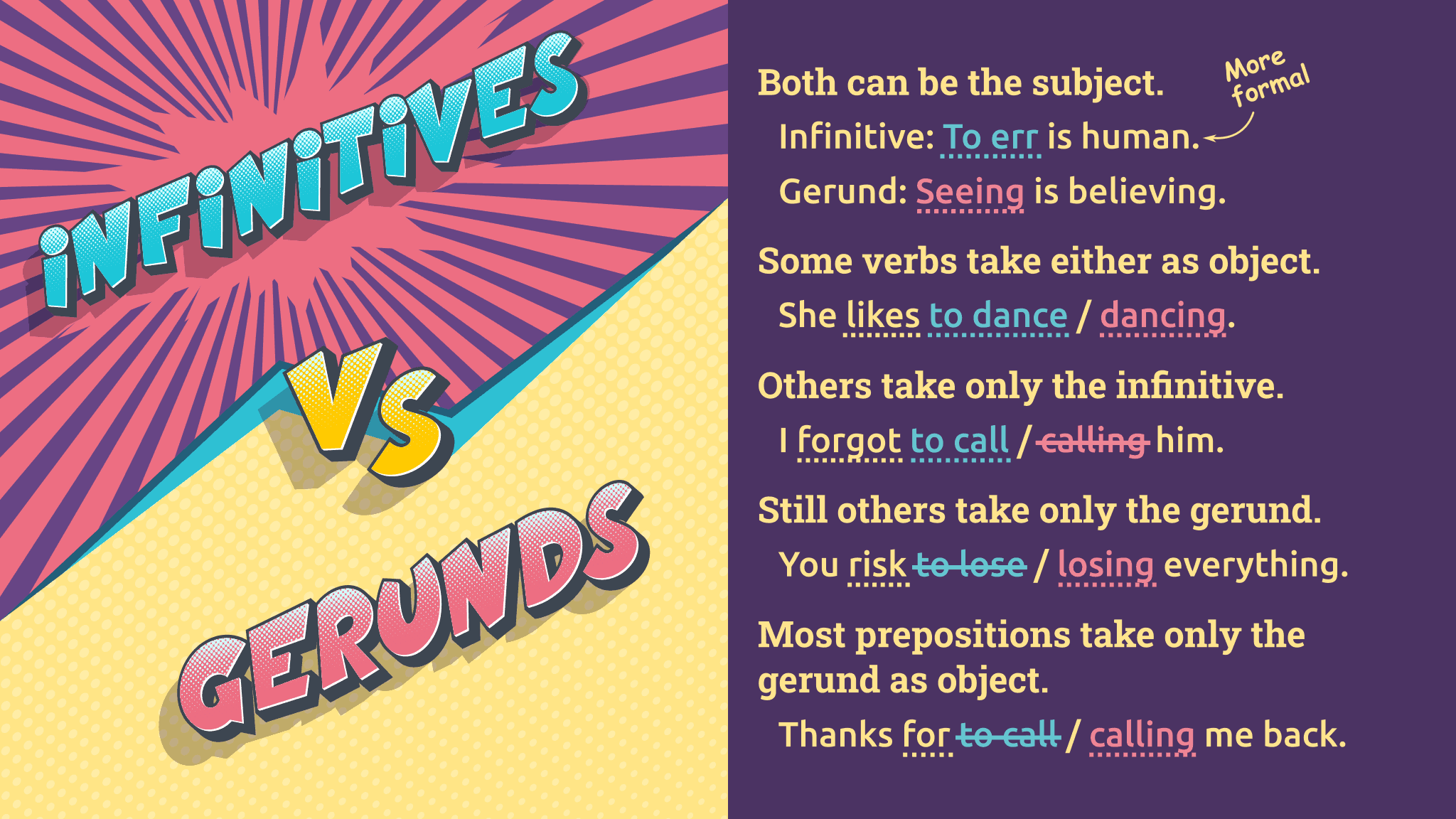
Gerunds are formed by adding “-ing” to the base form of a verb. They are used as subjects, objects, or complements in a sentence. For example, in the sentence “Swimming is my favorite hobby,” “swimming” is a gerund acting as the subject of the sentence. Gerunds can also follow prepositions, such as in the phrase “I am good at cooking.”
Infinitives, on the other hand, are the base form of a verb preceded by “to.” They can be used as subjects, objects, or complements in a sentence. For instance, in the sentence “To learn a new language is challenging,” “to learn” is an infinitive acting as the subject of the sentence. Infinitives can also follow certain verbs, such as “want,” “need,” or “decide,” as in the sentence “I want to travel the world.”
It is important to note that some verbs can be followed by either a gerund or an infinitive, but the meaning of the sentence may change depending on which form is used. For example, “I enjoy swimming” conveys a general sense of enjoyment for the activity, while “I enjoy to swim” sounds awkward and less commonly used.
Overall, mastering the usage of gerunds and infinitives takes practice and a keen eye for detail. By paying attention to the specific rules and contexts in which each form is used, English learners can enhance their language skills and communicate more effectively.
In conclusion, gerunds and infinitives are essential components of English grammar that serve as versatile tools for constructing sentences. Understanding the distinctions between these two verb forms can help improve one’s writing and speaking abilities. By practicing the proper usage of gerunds and infinitives, language learners can enhance their communication skills and convey their thoughts more clearly.