Pronouns are words that are used in place of nouns to avoid repetition. They can refer to people, places, things, or ideas. Understanding the different types of pronouns is essential in order to communicate effectively in writing or speech.
There are several different categories of pronouns, each serving a specific purpose in a sentence. Some common types include personal pronouns, possessive pronouns, reflexive pronouns, demonstrative pronouns, and indefinite pronouns.
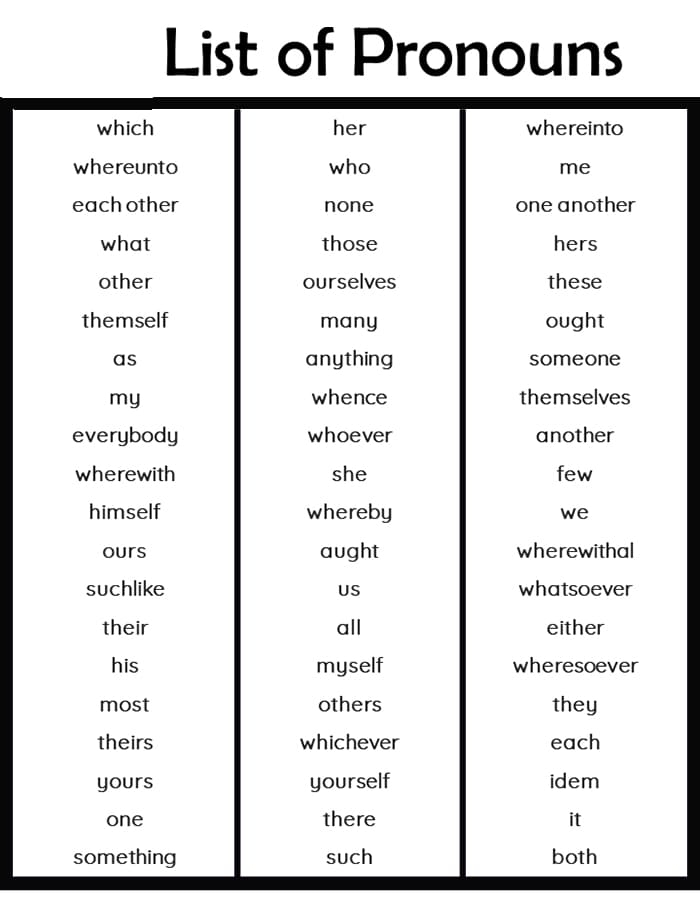
List of Pronouns:
- Personal Pronouns: I, you, he, she, it, we, they
- Possessive Pronouns: mine, yours, his, hers, its, ours, theirs
- Reflexive Pronouns: myself, yourself, himself, herself, itself, ourselves, themselves
- Demonstrative Pronouns: this, that, these, those
- Indefinite Pronouns: all, another, any, anybody, anyone, anything, both, each, either, everybody, everyone, everything, few, many, neither, nobody, none, no one, nothing, one, several, some, somebody, someone, something, such
Personal pronouns are used to refer to specific people or things. Possessive pronouns show ownership or possession. Reflexive pronouns are used when the subject and object are the same. Demonstrative pronouns point to specific things or people. Indefinite pronouns do not refer to any specific person or thing.
It is important to use pronouns correctly in order to avoid confusion in your writing. Make sure to match the pronoun with its antecedent and use the appropriate pronoun form based on the context of the sentence. Practice using different types of pronouns to enhance your communication skills.
In conclusion, pronouns play a crucial role in language by helping to simplify and clarify our communication. By understanding the various types of pronouns and how to use them effectively, you can improve the quality of your writing and speech. Practice using pronouns in different contexts to become more proficient in their usage.