Gerunds and participles are both verb forms that end in -ing, but they serve different purposes in a sentence. Understanding the difference between gerunds and participles is important for proper grammar usage.
Gerunds are verb forms that function as nouns in a sentence. They are created by adding -ing to a verb, such as “swimming” or “running.” Gerunds can be used as subjects, objects, or complements in a sentence.
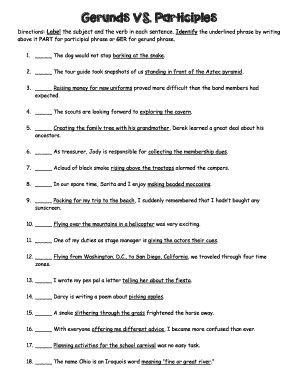
Participles, on the other hand, are verb forms that can function as adjectives or as part of a verb tense. There are two types of participles: present participles (ending in -ing) and past participles (ending in -ed, -en, -d, -t, -n). Participles are used to modify nouns or give additional information about the subject of a sentence.
One key difference between gerunds and participles is that gerunds always function as nouns, while participles can function as adjectives or parts of verbs. For example, in the sentence “I enjoy swimming,” “swimming” is a gerund that acts as the object of the verb “enjoy.” In contrast, in the sentence “The running man is fast,” “running” is a participle that modifies the noun “man.”
Another difference between gerunds and participles is their usage in verb phrases. Gerunds are often used in progressive verb tenses, such as “I am swimming,” where “swimming” is a gerund. Participles, on the other hand, are used in perfect verb tenses, such as “I have eaten,” where “eaten” is a past participle.
In conclusion, gerunds and participles are both verb forms that end in -ing, but they serve different functions in a sentence. Gerunds function as nouns, while participles can function as adjectives or parts of verbs. Understanding the difference between gerunds and participles is essential for proper grammar usage.