Medical terminology can often be confusing and overwhelming, especially for those who are not in the healthcare field. However, breaking down medical terms into their component parts can make it easier to understand and remember. One of the key components of medical terminology is prefixes and suffixes, which are added to the root word to modify its meaning. By learning common medical prefixes and suffixes, you can better understand the language of medicine.
Prefixes are added to the beginning of a word to modify its meaning. For example, the prefix “pre-” means before, so the word “preoperative” means before surgery. Some common medical prefixes include “anti-” (against), “hypo-” (below), “hyper-” (above), and “sub-” (under). By understanding the meanings of these prefixes, you can better understand the context of medical terms.
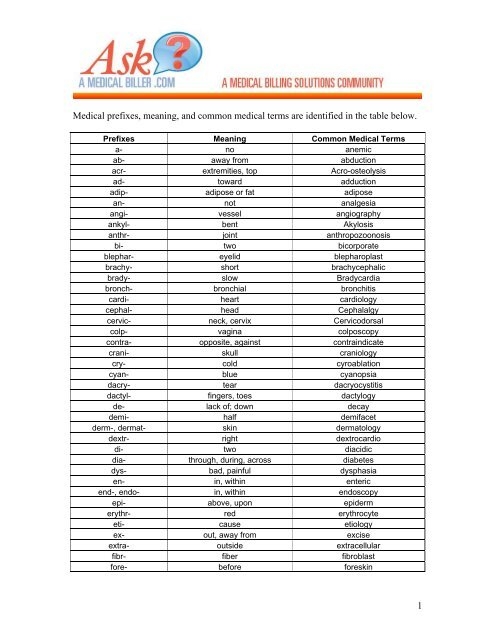
Medical Prefixes and Suffixes
Suffixes, on the other hand, are added to the end of a word to modify its meaning. For example, the suffix “-itis” means inflammation, so the word “tonsillitis” means inflammation of the tonsils. Some common medical suffixes include “-ology” (study of), “-ectomy” (surgical removal), “-algia” (pain), and “-osis” (condition). By learning these common suffixes, you can better understand the conditions and procedures described in medical terms.
Combining prefixes and suffixes with root words can create complex medical terms that describe specific conditions, procedures, or treatments. For example, the term “hypertension” combines the prefix “hyper-” (above) with the root word “tension” to describe high blood pressure. Similarly, the term “arthroscopy” combines the root word “arthro” (joint) with the suffix “-scopy” (examination) to describe a minimally invasive procedure to examine the joints.
Learning medical prefixes and suffixes can be a valuable tool for anyone interested in understanding medical terminology. By breaking down complex terms into their component parts, you can better understand the meaning and context of medical terms. Whether you are a healthcare professional, a student, or simply curious about the language of medicine, understanding prefixes and suffixes can help demystify the world of healthcare.
In conclusion, medical prefixes and suffixes play a crucial role in understanding the language of medicine. By learning common prefixes and suffixes, you can decode complex medical terms and better understand the conditions, procedures, and treatments described in healthcare settings. Take the time to familiarize yourself with these important components of medical terminology to enhance your knowledge and comprehension of the world of medicine.