Conditional sentences are used to express a hypothetical situation and its consequences. The second conditional is used to talk about imaginary situations in the present or future, while the third conditional is used to talk about imaginary situations in the past. It’s important to practice these conditional forms to become more fluent in English.
One way to practice 2nd and 3rd conditional sentences is through exercises. By doing exercises, you can improve your understanding of how these conditionals are formed and when to use them correctly.
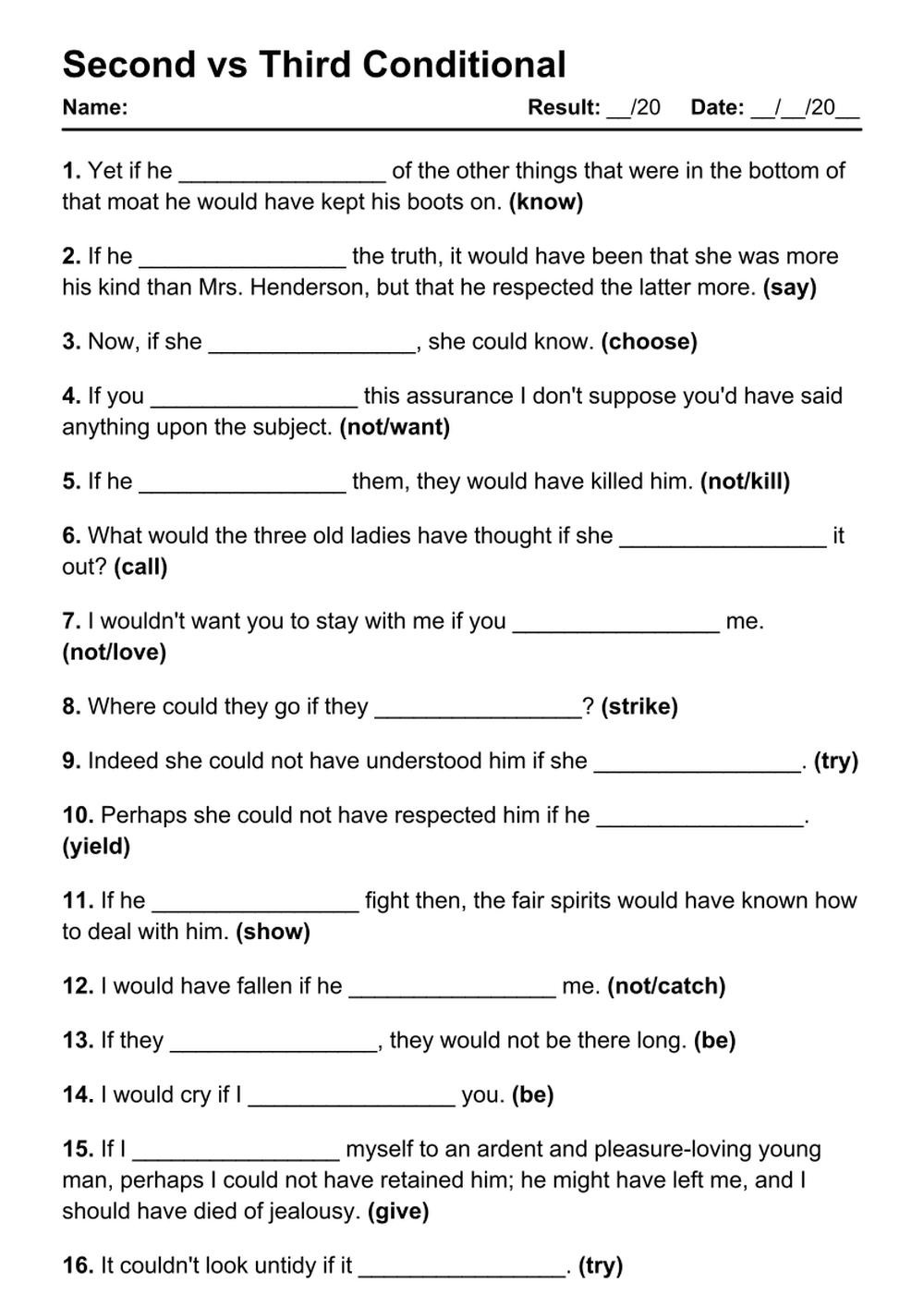
2nd Conditional Exercise
Here is an example of a 2nd conditional exercise:
“If I had more time, I would travel around the world.”
In this sentence, the condition is in the past tense (“had more time”) and the result is in the conditional form (“would travel around the world”). By practicing more exercises like this, you can become more comfortable with using the 2nd conditional in conversations and writing.
Another example of a 2nd conditional exercise is:
“If I were rich, I would buy a big house.”
In this sentence, the verb “to be” is conjugated as “were” because it is a hypothetical situation. These exercises help you understand the structure of the 2nd conditional and how to use it correctly.
3rd Conditional Exercise
Now let’s look at an example of a 3rd conditional exercise:
“If I had studied harder, I would have passed the exam.”
In this sentence, both the condition and the result are in the past tense. The condition is “had studied harder” and the result is “would have passed the exam.” Practicing exercises like this can help you master the 3rd conditional and use it accurately in your English communication.
Another example of a 3rd conditional exercise is:
“If it had not rained, we would have gone to the beach.”
In this sentence, the negative form is used in both the condition and the result. By practicing more exercises like this, you can improve your understanding of the 3rd conditional and how to apply it in different contexts.
In conclusion, practicing 2nd and 3rd conditional exercises is essential for improving your English language skills. By mastering these conditional forms, you can express hypothetical situations with greater confidence and accuracy. Keep practicing and you will see progress in your ability to use these conditionals effectively.