Adjectives are an essential part of speech that help to describe or modify nouns or pronouns. They provide more information about the noun or pronoun by giving details such as size, color, shape, and more. Without adjectives, our language would be less descriptive and vibrant.
Adjectives are versatile and can be used in various ways to enhance our writing and communication. They can be placed before the noun (e.g., “red apple”) or after linking verbs such as “is” or “seems” (e.g., “The sky is blue”). Adjectives play a crucial role in making our sentences more engaging and vivid.
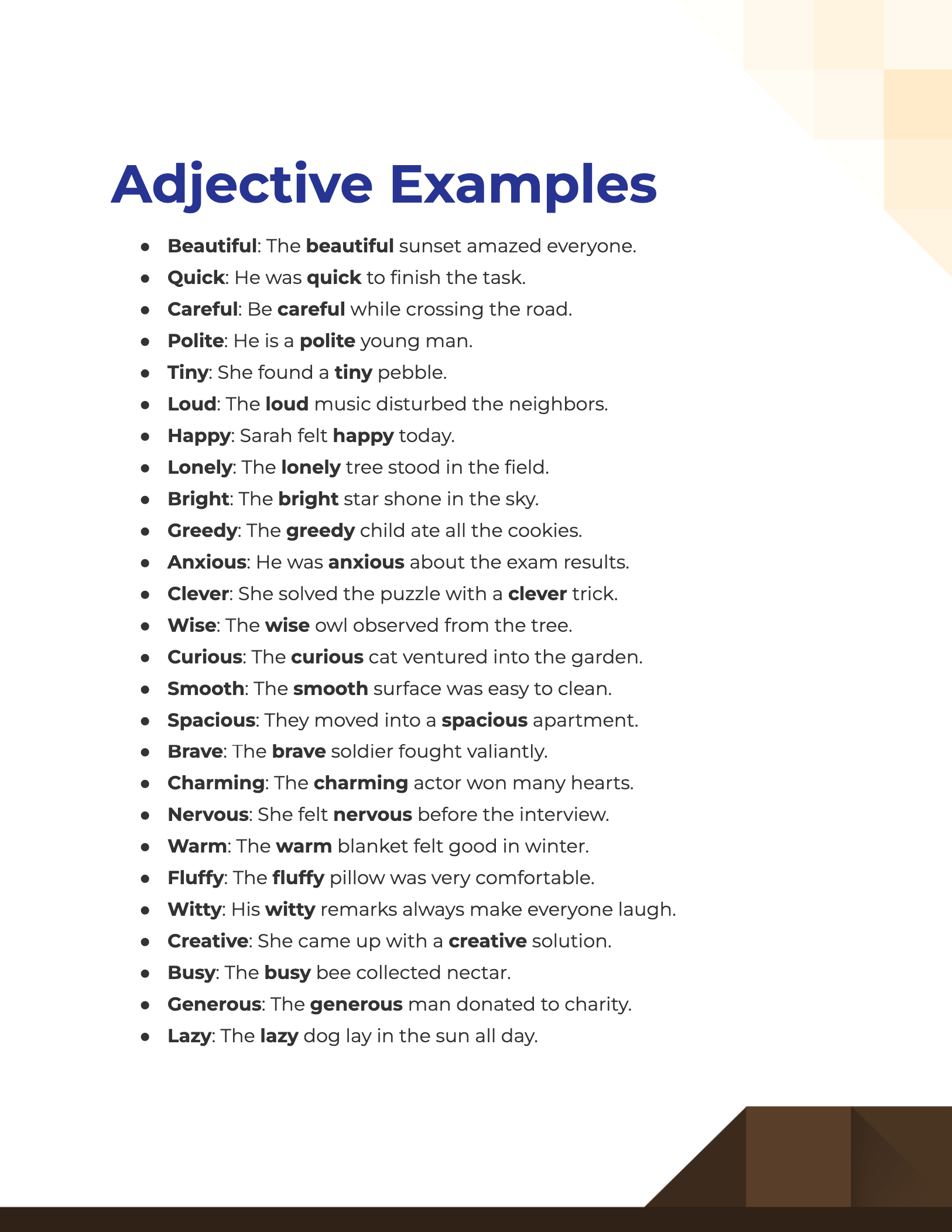
Examples of Adjectives
1. The beautiful sunset painted the sky with hues of orange and pink.
2. She wore a sparkling dress that shimmered under the lights.
3. The tall tower stood majestically against the backdrop of the city skyline.
4. His boisterous laughter filled the room with joy and merriment.
5. The delicious aroma of freshly baked bread wafted through the bakery.
Adjectives can vary in degrees of comparison, such as positive, comparative, and superlative forms. For example, “big” (positive), “bigger” (comparative), and “biggest” (superlative). They can also be used to specify the quantity or number of nouns (e.g., “three” books, “many” friends).
Adjectives are not limited to describing physical attributes but can also convey emotions, opinions, and attitudes. Words like “happy,” “sad,” “excited,” “angry,” and “proud” are examples of adjectives that express feelings and sentiments.
In conclusion, adjectives are powerful tools that add depth and color to our language. By using adjectives effectively, we can create vivid images, evoke emotions, and engage our readers or listeners. Whether describing a person, place, thing, or idea, adjectives help to enrich our communication and make our writing more compelling.