Subject-verb agreement is an important aspect of grammar that often causes confusion among writers and speakers. When constructing sentences, it is crucial to ensure that the subject and verb agree in number and person. This means that singular subjects must have singular verbs, and plural subjects must have plural verbs.
Failure to maintain subject-verb agreement can result in awkward and incorrect sentences that can confuse the reader. To avoid these mistakes, it is essential to understand the rules of subject-verb agreement and practice applying them in your writing.
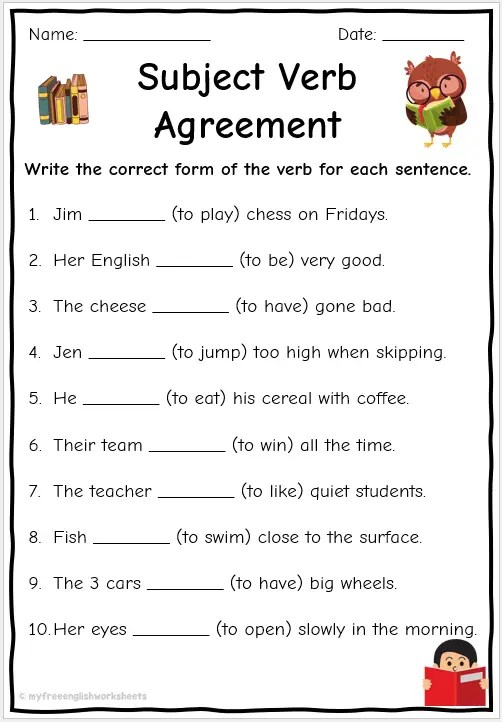
Here are some common subject-verb agreement questions that writers often encounter:
1. Does the verb agree with the subject when there is an intervening phrase?
In sentences with intervening phrases or clauses, it is important to identify the subject and ensure that the verb agrees with it. For example, “The book, along with several pens, is on the table.” In this sentence, the verb “is” agrees with the singular subject “book,” not the plural “pens.”
2. How do you handle collective nouns?
Collective nouns, such as team, family, or committee, can be singular or plural depending on how they are used in a sentence. If the collective noun is acting as a single unit, it should take a singular verb. For example, “The team is celebrating its victory.” If the collective noun is acting as individuals, it should take a plural verb. For example, “The team are arguing among themselves.”
3. What about indefinite pronouns?
Indefinite pronouns, such as everyone, someone, or each, are singular and should take singular verbs. For example, “Everyone is invited to the party.” However, some indefinite pronouns, like both, few, or many, are plural and should take plural verbs. For example, “Both are interested in the job.”
Subject-verb agreement is a fundamental aspect of grammar that can significantly impact the clarity and coherence of your writing. By understanding the rules and practicing with subject-verb agreement questions, you can improve your writing skills and communicate more effectively with your audience.
In conclusion, mastering subject-verb agreement is essential for writing clear and error-free sentences. By paying attention to the relationship between the subject and verb in your sentences, you can avoid common pitfalls and create stronger, more professional writing.