In the English language, possessive nouns and plural nouns play crucial roles in forming sentences. Possessive nouns show ownership or belonging, while plural nouns indicate that there is more than one of something. Understanding the difference between these two types of nouns is essential for clear and effective communication.
Using possessive nouns correctly can help clarify relationships between people or things in a sentence. For example, in the sentence “Sarah’s book is on the table,” the possessive noun “Sarah’s” indicates that the book belongs to Sarah. Without the possessive noun, the sentence would simply state that a book is on the table, without specifying whose book it is.
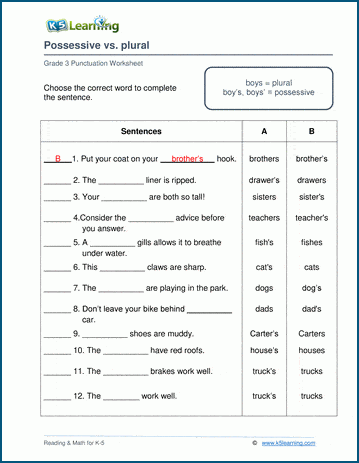
Possessive Nouns and Plural Nouns
Possessive nouns are formed by adding an apostrophe and an “s” (‘s) to the end of a singular noun, or just an apostrophe (‘) to the end of a plural noun that already ends in “s.” For example, “the dog’s tail” (singular possessive) or “the students’ desks” (plural possessive). Plural nouns, on the other hand, are formed by adding an “s” or “es” to the end of a singular noun to indicate that there is more than one of that noun.
It is important to note that possessive nouns and plural nouns can sometimes be confused, especially when dealing with nouns that end in “s.” For example, the sentence “The boss’ office is on the top floor” might seem correct, but technically it should be written as “The boss’s office is on the top floor” to show possession. Similarly, when dealing with plural possessive nouns, such as “the students’ books,” the apostrophe comes after the “s” because the books belong to multiple students.
When using possessive nouns and plural nouns in writing, it is essential to pay attention to the structure of the sentence to ensure clarity and accuracy. Incorrect usage of possessive or plural nouns can lead to confusion or ambiguity in communication. Practicing and understanding the rules of possessive and plural nouns can help improve overall writing skills.
In conclusion, possessive nouns and plural nouns are important components of the English language that help convey ownership and quantity. By mastering the use of possessive and plural nouns, writers can enhance the clarity and effectiveness of their communication. Remembering the rules and practicing proper usage can lead to improved writing skills and more precise expression.