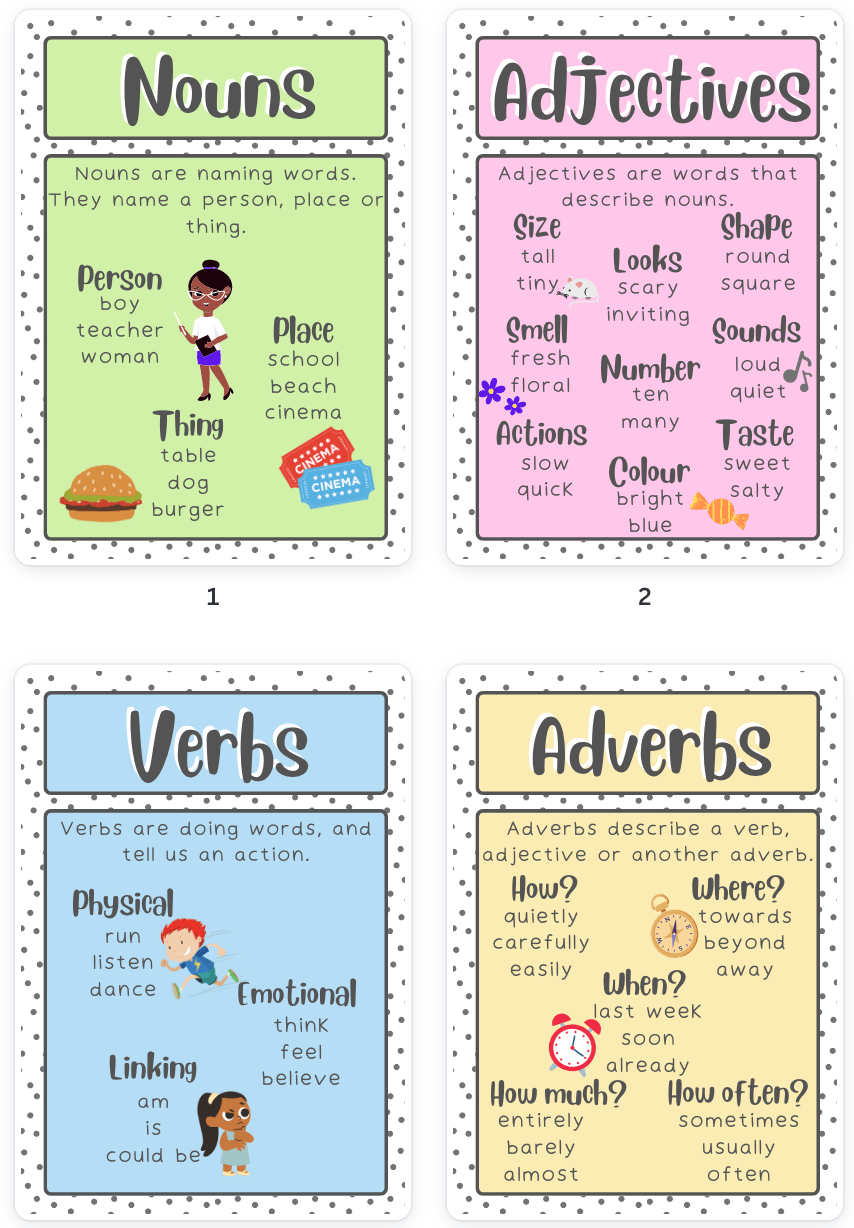
Adjectives, nouns, and verbs are essential components of the English language. Understanding how they work together is crucial for effective communication. Adjectives describe nouns, adding detail and specificity to the subject. Nouns are the names of people, places, things, or ideas. Verbs, on the other hand, express action or state of being. Together, these three parts of speech form the foundation of sentences and help convey meaning.
Adjectives are words that modify or describe nouns. They can indicate size, color, shape, or any other quality that helps to define the noun. For example, in the phrase “the beautiful flowers,” “beautiful” is the adjective that describes the noun “flowers.” Nouns, on the other hand, are the names of people, places, things, or ideas. They can be concrete, such as “table” or “dog,” or abstract, like “love” or “freedom.” Verbs, the final piece of the puzzle, express action or state of being. They show what the subject of the sentence is doing or experiencing.
When constructing sentences, it is important to ensure that adjectives, nouns, and verbs agree in number and tense. This means that if a noun is plural, the adjective and verb should also be plural. For example, in the sentence “The red apples are delicious,” “red” is the adjective that agrees with the plural noun “apples” and the verb “are.” Ensuring agreement between these parts of speech helps to create clear and coherent sentences.
Adjectives can also be used to compare two or more nouns. This is done by using comparative and superlative forms of the adjective. For example, in the sentence “She is taller than her sister,” the comparative form of the adjective “tall” is used to compare the heights of the two sisters. In the superlative form, the sentence could be written as “She is the tallest in her family.” Understanding how to use comparative and superlative adjectives can add nuance and depth to descriptions.
In conclusion, adjectives, nouns, and verbs are integral parts of the English language that work together to create meaningful communication. By understanding how these parts of speech interact and ensuring agreement between them, writers and speakers can construct clear and effective sentences. Whether describing the world around us, expressing emotions, or narrating stories, adjectives, nouns, and verbs play a vital role in conveying meaning.