When it comes to pronouns, there are various types that serve different purposes in the English language. Pronouns are words that can replace nouns in a sentence, making it easier to refer to someone or something without repeating the noun. Understanding the different types of pronouns can help improve your writing and communication skills.
From personal pronouns to possessive pronouns, each type has its own unique function. Let’s explore the various pronouns that exist in the English language and how they are used in sentences.
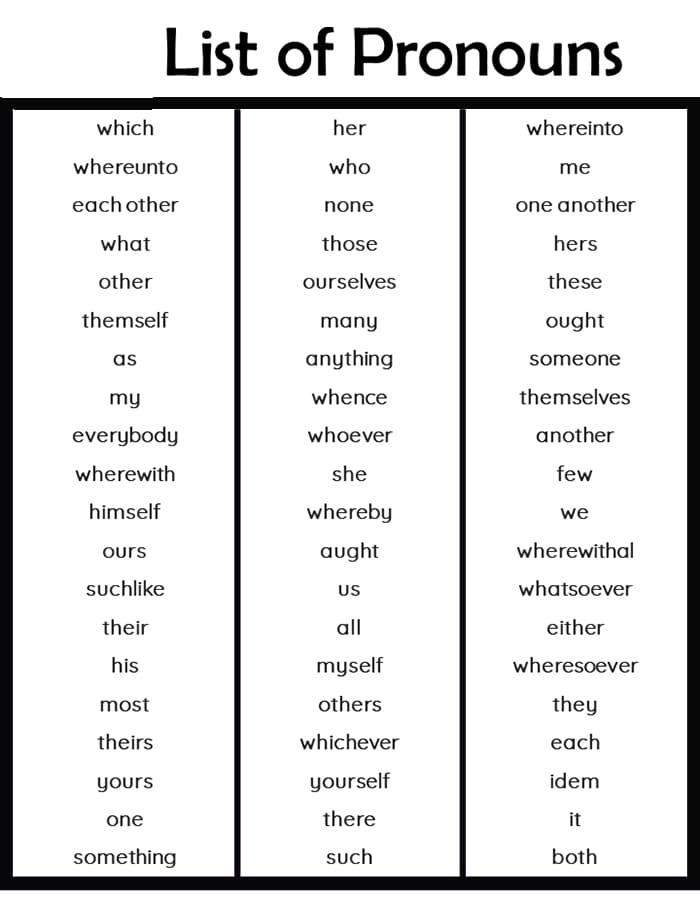
Types of Pronouns:
1. Personal Pronouns: Personal pronouns refer to specific people or things. They include pronouns like I, you, he, she, it, we, and they. Personal pronouns can also be used to show possession, such as my, your, his, her, its, our, and their.
2. Demonstrative Pronouns: Demonstrative pronouns are used to point out specific people or things. Examples include this, that, these, and those. Demonstrative pronouns help clarify which person or object is being referred to in a sentence.
3. Reflexive Pronouns: Reflexive pronouns are used when the subject and object of a sentence are the same. Examples include myself, yourself, himself, herself, itself, ourselves, yourselves, and themselves. Reflexive pronouns are used for emphasis or to show that the action is being performed by the subject.
4. Interrogative Pronouns: Interrogative pronouns are used to ask questions. Examples include who, whom, whose, which, and what. Interrogative pronouns help gather information and clarify details in a conversation or written text.
5. Indefinite Pronouns: Indefinite pronouns refer to nonspecific people or things. Examples include anyone, someone, no one, everybody, nobody, everything, and nothing. Indefinite pronouns are used when the exact identity of the person or thing is unknown or irrelevant.
Understanding the different types of pronouns and how they are used in sentences can help improve your writing and communication skills. By incorporating various pronouns into your writing, you can make your sentences more concise and engaging. Practice using different pronouns in your writing to become more familiar with their usage and enhance your language skills.