Auxiliary helping verbs, also known as auxiliary verbs, are used in conjunction with main verbs to help express the various tenses, moods, voices, and aspects of the main verb. They play an important role in forming grammatically correct sentences in English.
Common auxiliary helping verbs include “be,” “do,” and “have.” These verbs are used in different ways to convey different meanings and nuances in a sentence. Understanding how to use auxiliary helping verbs correctly can greatly improve your English language skills.
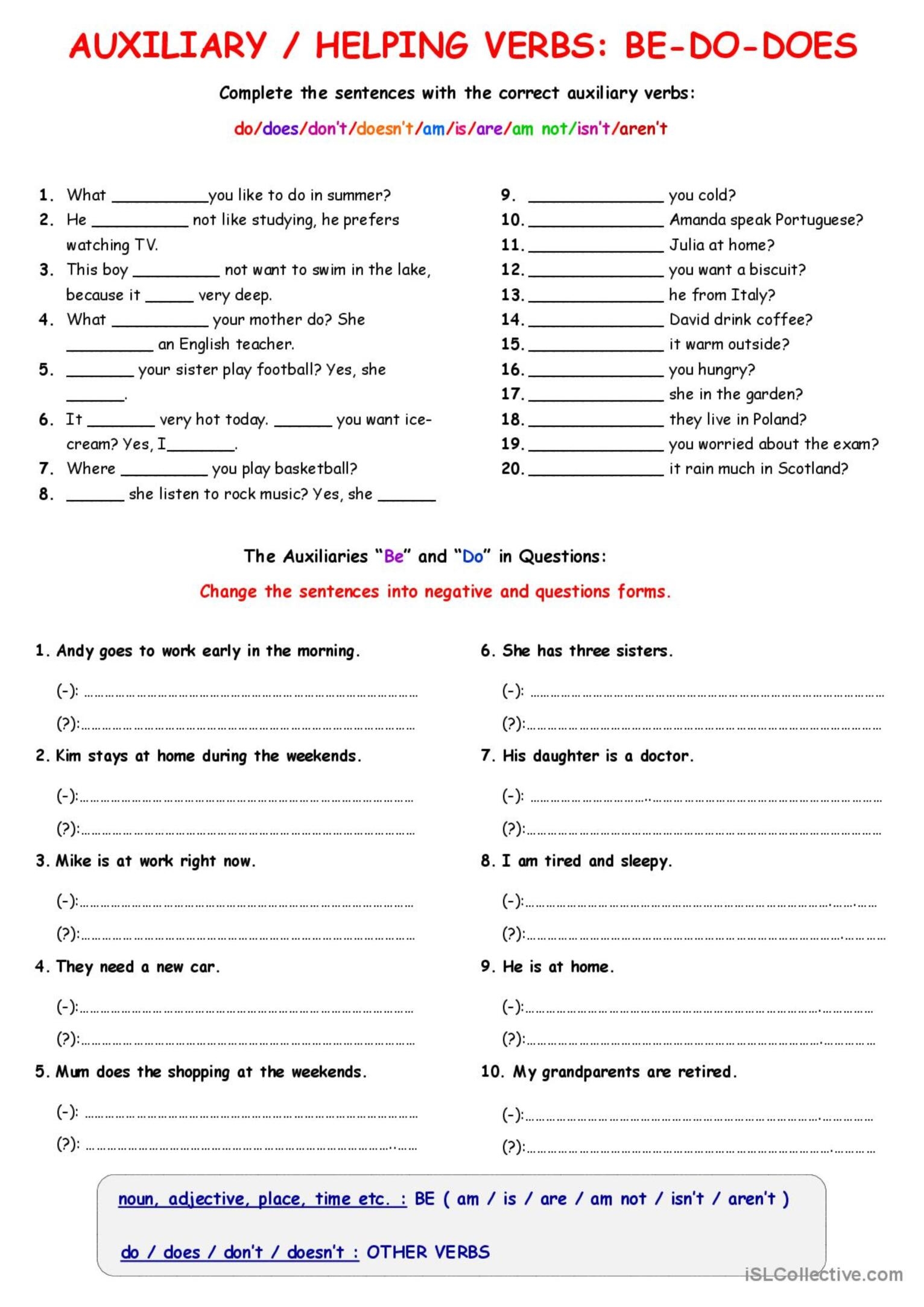
Examples of Auxiliary Helping Verbs
One common use of auxiliary helping verbs is in forming the present perfect tense. For example, in the sentence “I have finished my homework,” the auxiliary verb “have” is used to indicate that the action of finishing the homework occurred at some point in the past and is relevant to the present moment.
Auxiliary helping verbs can also be used to form questions and negations. In the sentence “She does not like coffee,” the auxiliary verb “does” is used to create a negative statement. Similarly, in the question “Do you speak Spanish?” the auxiliary verb “do” is used to form an interrogative sentence.
Another common use of auxiliary helping verbs is in expressing the passive voice. In the sentence “The cake was baked by my mom,” the auxiliary verb “was” is used to indicate that the cake did not bake itself, but rather, it was baked by someone else.
It is important to note that auxiliary helping verbs can vary depending on the tense, mood, voice, and aspect of the main verb. By mastering the use of auxiliary helping verbs, you can enhance the clarity and precision of your writing and communication.
In conclusion, auxiliary helping verbs are essential components of English grammar that help convey the nuances of language. By understanding how to use auxiliary helping verbs effectively, you can improve your language skills and communicate more clearly. Practice using auxiliary helping verbs in various contexts to become more proficient in English grammar.