Nouns are a fundamental part of the English language and play a crucial role in forming sentences. They are words that represent people, places, things, or ideas. Nouns are essential for communication as they help us identify and specify what we are talking about.
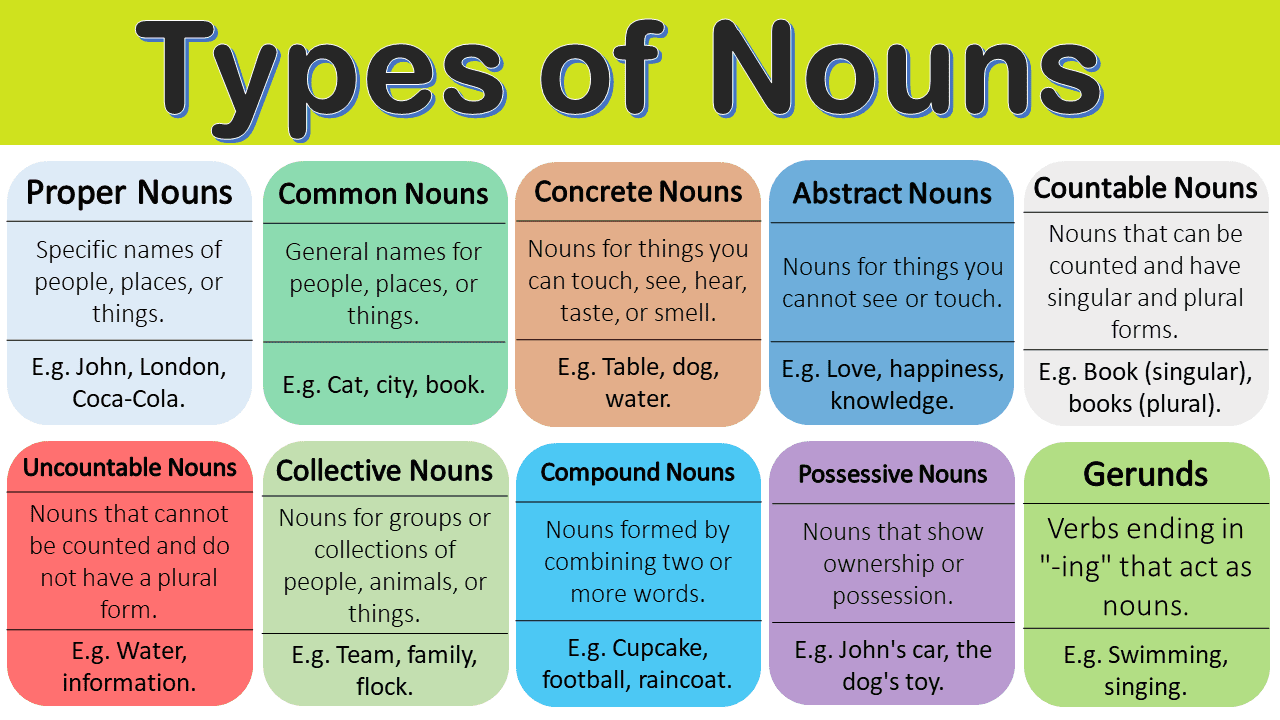
There are different types of nouns, including common nouns, proper nouns, abstract nouns, concrete nouns, collective nouns, and countable and uncountable nouns. Each type serves a specific purpose in a sentence and helps convey meaning accurately.
Define Nouns
A noun is a word that names a person, place, thing, or idea. It can be a subject, object, or complement in a sentence. Nouns can be singular or plural, and they can also be categorized into different types based on their function and usage in sentences.
Common nouns refer to general or non-specific people, places, things, or ideas. For example, “dog,” “city,” and “love” are common nouns. Proper nouns, on the other hand, refer to specific people, places, things, or ideas and are always capitalized, such as “John,” “New York,” and “Disneyland.”
Abstract nouns represent concepts, emotions, or qualities that cannot be perceived by the senses, like “love,” “happiness,” and “freedom.” Concrete nouns, on the other hand, refer to physical objects that can be seen, touched, or experienced, such as “table,” “car,” and “tree.”
Collective nouns are used to refer to a group of people, animals, or things as a single entity, such as “family,” “herd,” or “team.” Countable nouns can be quantified and have singular and plural forms, like “book” and “books.” Uncountable nouns, on the other hand, cannot be counted individually, like “water” and “air.”
In conclusion, nouns are essential building blocks of the English language that help us communicate effectively and convey meaning in sentences. By understanding the different types of nouns and how they function in sentences, we can enhance our language skills and improve our ability to express ourselves clearly and accurately.