When it comes to language, pronouns play a crucial role in helping us communicate effectively. Pronouns are words that take the place of nouns in a sentence, making our speech and writing more concise and fluid. Without pronouns, our sentences would be repetitive and cumbersome. Understanding how to use pronouns correctly is essential for clear and efficient communication.
Pronouns can be divided into several categories, each serving a specific function in a sentence. Personal pronouns, such as “I,” “you,” “he,” “she,” “it,” “we,” and “they,” refer to specific people or things. Possessive pronouns, like “mine,” “yours,” “his,” “hers,” “ours,” and “theirs,” indicate ownership or association. Demonstrative pronouns, such as “this,” “that,” “these,” and “those,” point to specific items or people. Interrogative pronouns, like “who,” “whom,” “whose,” “which,” and “what,” are used to ask questions. Finally, indefinite pronouns, such as “anyone,” “someone,” “everyone,” “nothing,” and “everything,” refer to nonspecific people or things.
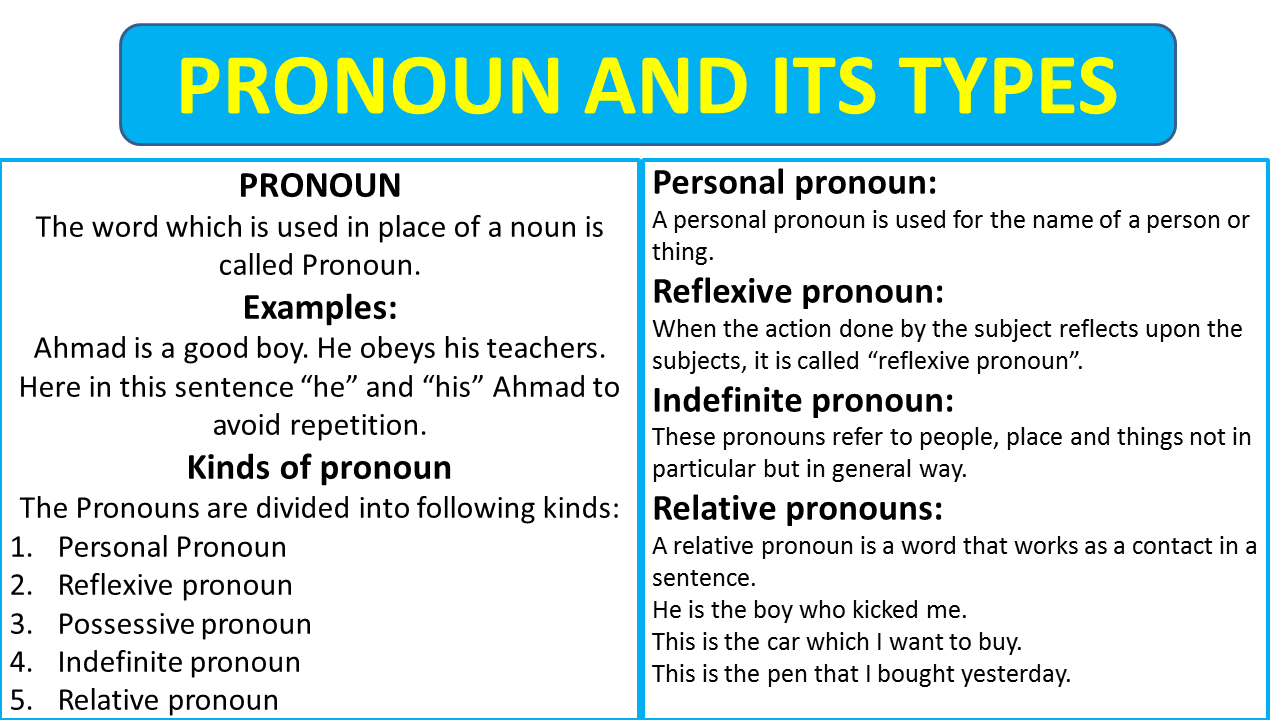
Define Pronoun
A pronoun is a word that takes the place of a noun in a sentence. It helps to avoid repetition and make sentences more concise. For example, instead of saying “Mary went to the store, and Mary bought a new dress,” we can use pronouns to say “Mary went to the store, and she bought a new dress.” This makes the sentence flow better and is easier to understand.
Using pronouns correctly is essential for clarity and coherence in writing. It is important to match the pronoun with its antecedent, the noun it replaces, to avoid confusion. For example, if we say “The dog lost its collar,” the pronoun “its” refers back to the noun “dog.” Using the wrong pronoun or failing to match it with the correct antecedent can lead to ambiguity or grammatical errors.
In addition to simplifying sentences, pronouns also help to maintain coherence and flow in writing. They allow us to refer back to previously mentioned nouns without repeating them, creating a smooth and logical progression of ideas. By mastering the use of pronouns, writers can enhance the readability and effectiveness of their communication.
In conclusion
Pronouns are an essential part of language that help us communicate efficiently and effectively. By understanding the different types of pronouns and how to use them correctly, we can improve the clarity and coherence of our writing. Whether in spoken or written communication, pronouns play a vital role in making our language more concise and understandable.