Understanding the difference between gerunds and infinitives can be tricky for English learners. Both are verb forms that can function as nouns, but they have different uses and rules. Gerunds end in -ing, while infinitives are the base form of the verb preceded by “to.” Let’s explore some examples to clarify the distinction between gerunds and infinitives.
Gerunds are often used as subjects of sentences, objects of prepositions, and objects of verbs. They can also follow certain verbs as direct objects. On the other hand, infinitives are used after certain verbs, adjectives, and nouns, and can also function as the subject or object of a sentence. Let’s look at some examples to illustrate the differences between gerunds and infinitives.
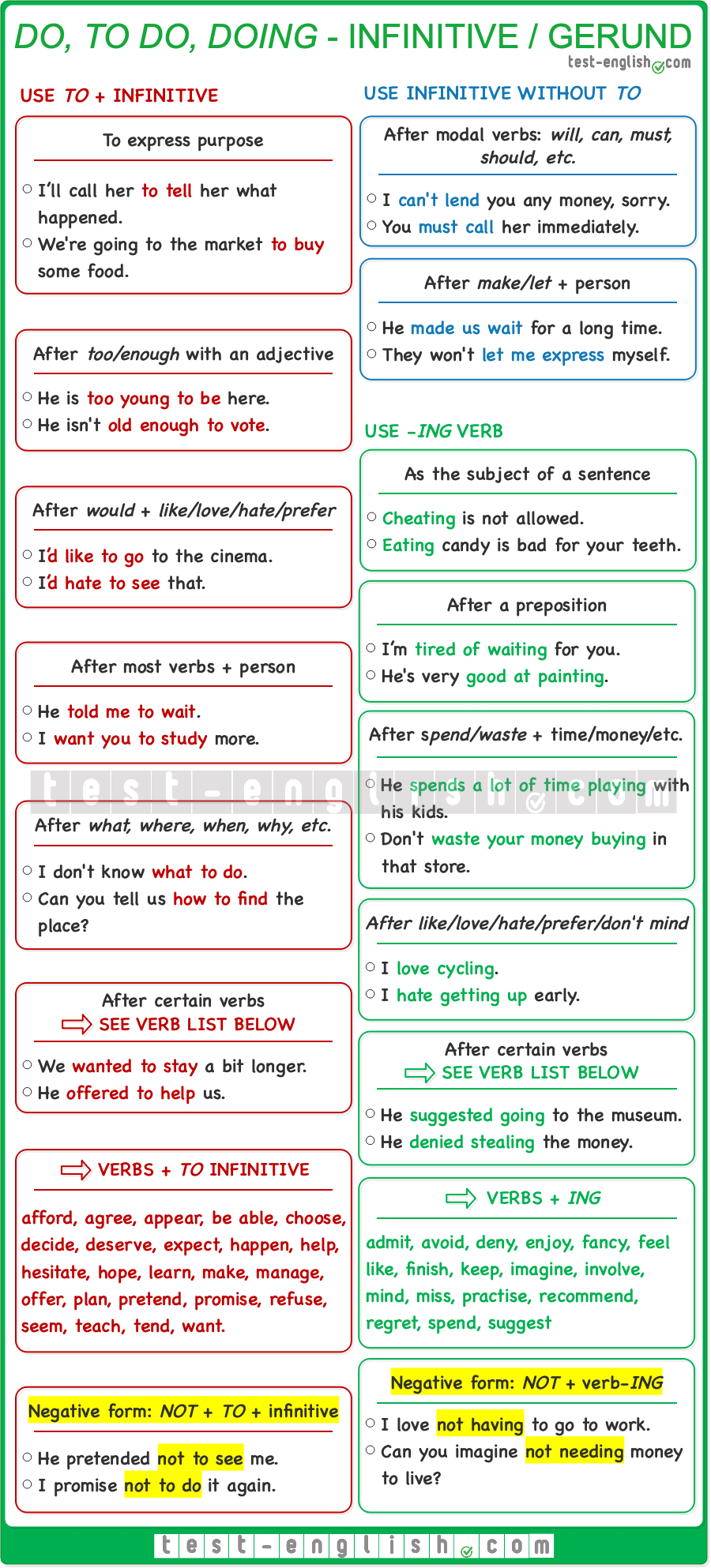
Examples:
1. Gerund: Swimming is my favorite hobby.
Infinitive: I love to swim in the ocean.
2. Gerund: She enjoys reading books in her free time.
Infinitive: She wants to read a novel tonight.
3. Gerund: Running in the park is good for your health.
Infinitive: He needs to run five miles every day.
4. Gerund: I am interested in learning new languages.
Infinitive: She decided to learn Spanish this summer.
5. Gerund: Playing the piano brings me joy.
Infinitive: He hopes to play at Carnegie Hall one day.
Both gerunds and infinitives have specific roles in English grammar, and choosing the correct form can impact the meaning of a sentence. Practice using gerunds and infinitives in context to improve your understanding of when to use each form. With time and practice, you’ll become more confident in distinguishing between gerunds and infinitives in your writing and speaking.
In conclusion, mastering the use of gerunds and infinitives is essential for achieving fluency in English. By studying examples and practicing their application in sentences, you can enhance your language skills and communicate more effectively. Remember to pay attention to the context and rules governing the use of gerunds and infinitives to avoid confusion and errors in your writing.