Verbs are an essential part of the English language, as they convey action or state of being. Intransitive and transitive verbs are two types of verbs that are commonly used in sentences. Understanding the difference between these two types of verbs is crucial for constructing clear and concise sentences.
Intransitive verbs are verbs that do not require a direct object to complete their meaning. These verbs often describe actions that do not transfer the action to an object. For example, in the sentence “The cat sleeps,” the verb “sleeps” is intransitive because it does not require a direct object to complete the meaning.
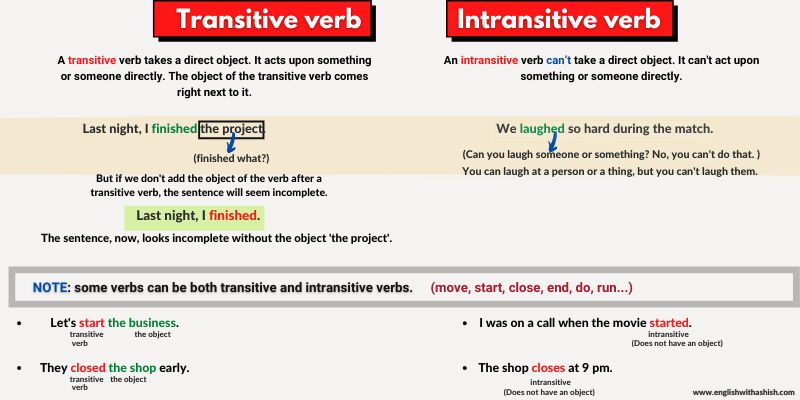
Intransitive vs Transitive Verbs
On the other hand, transitive verbs are verbs that require a direct object to complete their meaning. These verbs often describe actions that transfer the action to an object. For example, in the sentence “She ate a sandwich,” the verb “ate” is transitive because it requires a direct object (a sandwich) to complete the meaning.
It is essential to note that some verbs can be both intransitive and transitive, depending on how they are used in a sentence. For example, the verb “run” can be intransitive in the sentence “The children run in the park,” where it does not require a direct object. However, it can also be transitive in the sentence “She runs a successful business,” where it requires a direct object (a successful business) to complete the meaning.
When constructing sentences, it is important to identify whether a verb is intransitive or transitive to ensure that the sentence is grammatically correct and conveys the intended meaning. Using intransitive verbs without a direct object or transitive verbs without a direct object can lead to confusion and ambiguity in a sentence.
In conclusion, understanding the difference between intransitive and transitive verbs is essential for constructing clear and concise sentences. Intransitive verbs do not require a direct object to complete their meaning, while transitive verbs do. By identifying whether a verb is intransitive or transitive, writers can ensure that their sentences are grammatically correct and effectively convey their intended message.