Pronouns are words that are used in place of nouns in a sentence. They help avoid repetition and make sentences flow more smoothly. There are various types of pronouns in the English language, each serving a specific purpose. Understanding pronouns is essential for effective communication and writing.
Below is a list of pronouns categorized by their types:
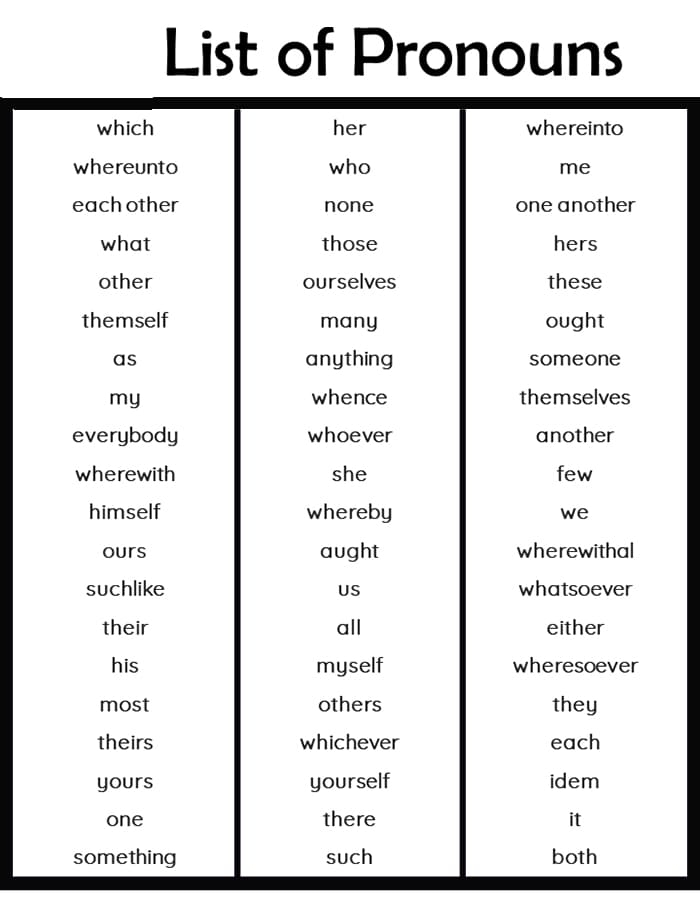
1. Personal Pronouns
Personal pronouns refer to specific persons or things. They can be singular or plural and vary based on gender.
Examples:
- I (singular, first person)
- You (singular or plural, second person)
- He, She, It (singular, third person)
- We (plural, first person)
- They (plural, third person)
2. Possessive Pronouns
Possessive pronouns show ownership or possession. They indicate that something belongs to someone.
Examples:
- My, Mine (first person)
- Your, Yours (second person)
- His, Her, Hers, Its (third person)
- Our, Ours (first person plural)
- Their, Theirs (third person plural)
3. Demonstrative Pronouns
Demonstrative pronouns point to specific things or people. They help identify what is being referred to in a sentence.
Examples:
- This, That (singular)
- These, Those (plural)
4. Reflexive Pronouns
Reflexive pronouns are used when the subject and object of a sentence are the same. They end in -self or -selves.
Examples:
- Myself, Yourself, Himself, Herself, Itself
- Ourselves, Yourselves, Themselves
In conclusion, pronouns play a crucial role in language and communication. By using pronouns effectively, we can make our writing clearer and more concise. It is important to understand the different types of pronouns and how they function in sentences. Practice using pronouns in your writing to improve your language skills and enhance your communication abilities.